
How a Delphi Process Can Help Build a Standard of Care for Deterioration or Regression in Individuals with Autism
A Roadmap to Better Care
By Pramila Srinivasan, Ph.D. (reviewed and edited by Dr. Frankovich, Stanford University)
A plain-language look at how experts turn fragmented knowledge into shared clinical understanding and protocols – and how a new Stanford/BRAIN Foundation conference aims to bring the Delphi process to behavioral/neuropsychiatric deterioration in people with autism. This conference will be the first multidisciplinary Delphi initiative focused specifically on the evaluation and treatment of severe neuropsychiatric deteriorations in youth and young adults with autism.
The central idea:
When existing research is fragmented or insufficient to provide clear practical guidance, a rigorous Delphi process can help develop structured, transparent, expert-informed recommendations for clinicians. These recommendations may assist clinicians in recognizing, assessing, and managing potentially organic causes of clinical deterioration. Although Delphi consensus does not establish a definitive standard of care and cannot replace high-quality empirical evidence, it can provide a responsible interim framework when urgent clinical decisions are required. The resulting guidance will be explicitly linked to the available evidence, regularly reviewed, and tested in practice and research. Through an iterative, coordinated process that brings together relevant clinical, scientific, and patient perspectives, the recommendations can be refined as stronger evidence becomes available.
The problem families know too well
A child or adult with autism changes. Sleep collapses. Language or daily-living skills recede. Severe anxiety, agitation, compulsive behavior, catatonia-like symptoms, seizures, movement changes, or unexplained distress or aggression may appear. The change may be rapid, episodic, or progressive. Families know that something is different – but the health-care system may not have a common playbook for responding.
One clinician may focus on psychiatric symptoms. Another may look for seizures, medication effects, or a sleep disorder. A third may assume the change is simply part of autism. This last response has a name: diagnostic overshadowing – when new symptoms are attributed to a person’s disability before potentially treatable causes have been adequately considered. Treatable conditions can be missed, such as infections, post-infectious inflammatory conditions, autoimmune diseases, and pain reflecting arthritis, bowel inflammation, and constipation.
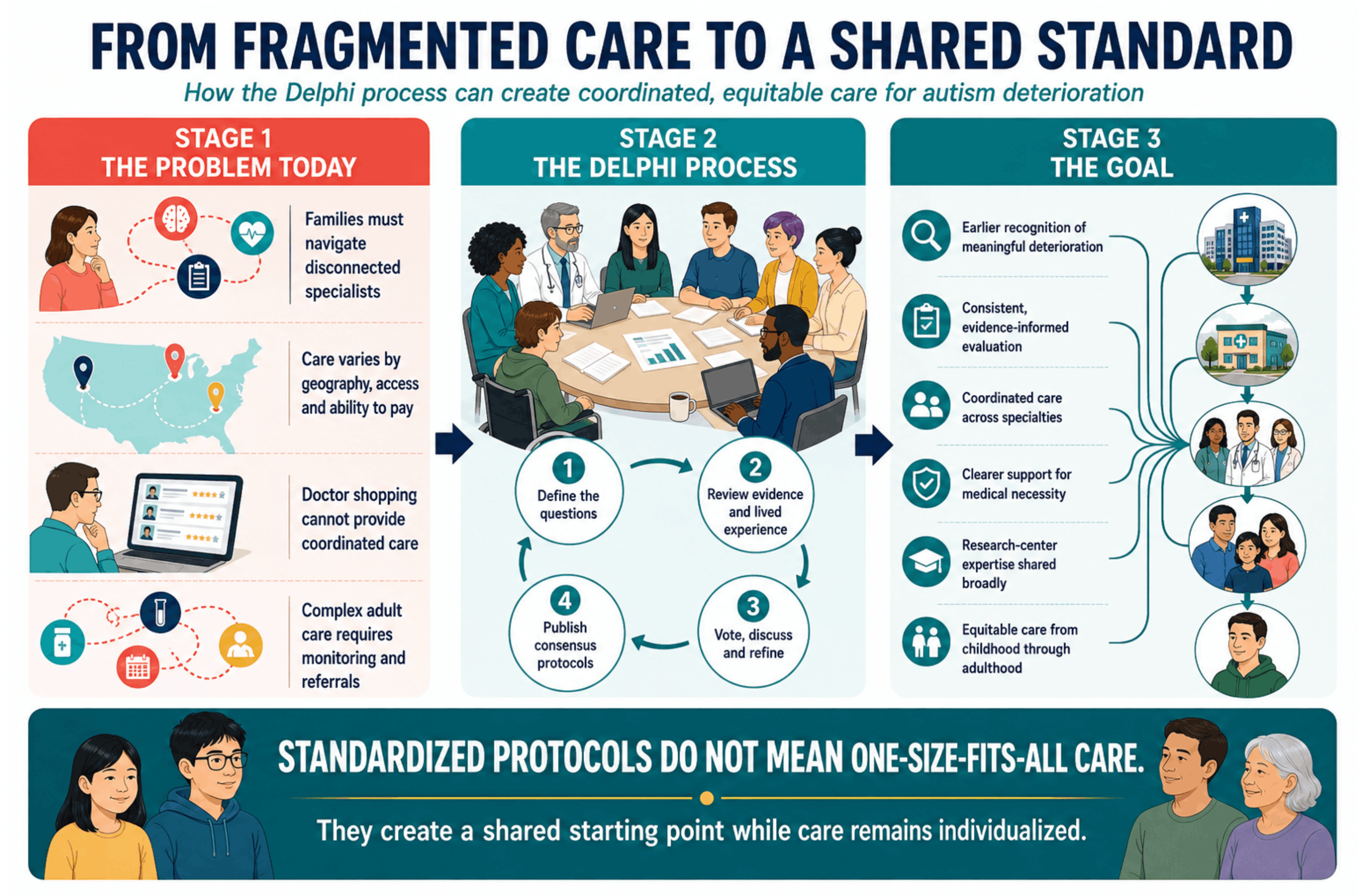
The result is not merely variation in opinion. It can mean delayed evaluation, repeated emergency visits, missed medical illness, fragmented referrals, and families left to coordinate complex care on their own. The field needs a shared starting point: a practical way to identify meaningful deterioration, compare it with the person’s baseline, assess urgency, and consider medical, neurological, psychiatric, environmental, and medication-related contributors together.
Why a standard of care is necessary
Access to Care: Today, access to a thorough evaluation can depend too heavily on where a family lives, whom they know, what they can afford, and whether they happen to find a clinician familiar with autism deterioration. Families may travel across states, pay out of pocket, or move from doctor to doctor searching for someone who will investigate the change beyond a psychosocial viewpoint. This is often described dismissively as ‘doctor shopping.’ In reality, it can be a rational response to a system without a consistent pathway.
But doctor shopping is not coordinated care. Each new clinician may see only one episode, one organ system, or one piece of a long and complicated history. Records may not follow promptly or accurately, earlier treatment responses may be missed, and no single team may be responsible for connecting the findings. Families are forced to become the medical record, the care coordinator, and the referral generator. Even when they find helpful clinicians, a collection of disconnected opinions cannot substitute for a coordinated longitudinal plan.
Continuity and Coordination of Care: The need for coordinated care is especially important as youth with autism transition into adulthood. Adult health-care services can be more fragmented, and an individual’s health needs may become more complex over time. For people receiving several therapies or medications, safe care may require regular laboratory testing and other safety monitoring; careful review of possible medication interactions and combined effects; and objective follow-up to assess both potential benefits and unwanted effects. Depending on the person’s needs, referrals may also be appropriate to specialists such as neurologists, psychiatrists, gastroenterologists, rheumatologists, immunologists, sleep medicine physicians, geneticists, or others. Complex care involving multiple treatments should not rely solely on separate, unconnected appointments. It is best supported by a coordinated clinical “home,” with clear responsibility for overseeing care, shared medical documentation, and agreed-upon plans for when additional evaluation, specialist referral, or more urgent support is needed.
Evidence based Quality Care: Families should not need extraordinary persistence or resources to receive ordinary medical diligence. A standard protocol can define the minimum expected response: listen to the family, establish whether the person has departed from baseline, screen for urgent risks, consider a broad differential diagnosis, order testing when clinically indicated, and coordinate appropriate follow-up. It does not require every patient to receive every test or treatment. It requires each patient to receive a reasoned, evidence-informed evaluation appropriate to the presentation.
Access to Medical Research Centers: Large research medical centers offer tangible advantages for this care: multidisciplinary expertise, access to advanced diagnostics, experience with uncommon presentations, research infrastructure, and the ability to bring several specialties around the same patient. They are natural hubs for developing, testing, and refining complex-care protocols. Yet a family’s access to coordinated care should not depend forever on reaching one famous institution or one exceptional physician. Standardized protocol development is what allows the knowledge of a research center to become a reproducible pathway – one that can be shared with community clinicians, used to guide referrals, and extended across the transition from pediatric to adult care.
Equity and Standardization: Standardization is also a matter of equity. People with limited income, rural families, communities of color, nonspeaking people, and those without access to major academic centers are least able to navigate a fragmented system. Clear protocols can help bring the same clinical reasoning to a community clinic or emergency department that might otherwise be available only through a specialist network.
Affordability: It is a matter of insurance coverage as well. When there is no recognized pathway, medically appropriate evaluations may appear unusual, inconsistent, or ‘experimental’ to a payer. Published consensus guidance can help clinicians document medical necessity, support consistent authorization and coverage decisions, and give families a clear basis for appeal. It cannot guarantee that every insurer will cover every service; broader adoption, evidence, coding, and payer policy are still required. But without consensus, equitable coverage is far harder to achieve.
What exactly is a Delphi process?
Despite its mysterious name, a Delphi is not a single meeting where prominent experts vote and declare an answer. It is a structured, iterative process for gathering and refining the views of a group of experts. It is designed to support decision-making when evidence is incomplete, uncertainty is high, or direct discussion might be influenced by seniority, reputation, or strong personalities. Participants provide their views independently and anonymously over several rounds, with controlled feedback between rounds, until consensus is reached or remaining disagreement is clearly documented. It can be understood as a carefully designed conversation conducted in stages.(See RAND Project reference below)
Definition: The Delphi method is an iterative, anonymous, structured, group-based communication process and elicitation technique designed to help policymakers make decisions under conditions of uncertainty and incomplete information.
Think of it as a carefully designed conversation conducted in rounds:
- Define the questions. A steering group identifies the clinical decisions for which guidance is needed.
- Recruit an appropriate panel. The panel includes experts from relevant specialties and where appropriate, individuals with responsibility for implementing or advocating for the resulting recommendations within their institutions.
- Develop clear, focused statements. Broad issues are translated into specific, answerable propositions. For example: Which clinical changes should prompt an urgent medical assessment?
- Collect independent ratings. Panelists score their agreement. Responses are commonly anonymised so reputation, seniority, and force of personality do not determine the result.
- Provide structured feedback: Participants are shown a summary of the group’s responses, including the level of agreement and, where relevant, the reasons for differing views.
- Revise and repeat. Statements are clarified, narrowed, or rejected over additional rounds until a pre-defined threshold for consensus is met – or disagreement is transparently reported.
- Publish, implement, and evaluate: The process and resulting recommendations are documented, peer reviewed, implemented in clinical practice, and ultimately real-world outcomes are evaluated with prospective data collection. Recommendations can then be updated as new evidence emerges.
In summary, the Delphi process (managed by an expert) is characterized by:
- Anonymity
- Iteration over multiple rounds of voting
- Feedback after each round
- Statistical summaries of group response
Why use Delphi in an emerging area of medicine?
Randomized trials remain essential for determining whether a treatment works and is safe. However, trials cannot answer every practical question needed at the front door of care: What counts as a clinically meaningful change? Which warning signs require rapid action? What history should be taken? Which diagnoses should be considered? When is outpatient care insufficient?
In areas where research is still developing, clinicians who care for patients often have important—but scattered—experience. A Delphi process is one way to gather that experience systematically. It asks a diverse group of experts to review available evidence, consider proposed recommendations, rate them independently, discuss areas of disagreement, and repeat the process over several rounds.
The value of Delphi is not that experts are always correct. Rather, it provides a structured and transparent way to make expert judgment visible, test it across disciplines, and clearly identify areas of agreement and areas where uncertainty remains. Its design also helps reduce the influence of any single dominant voice.
From consensus to a standard of care
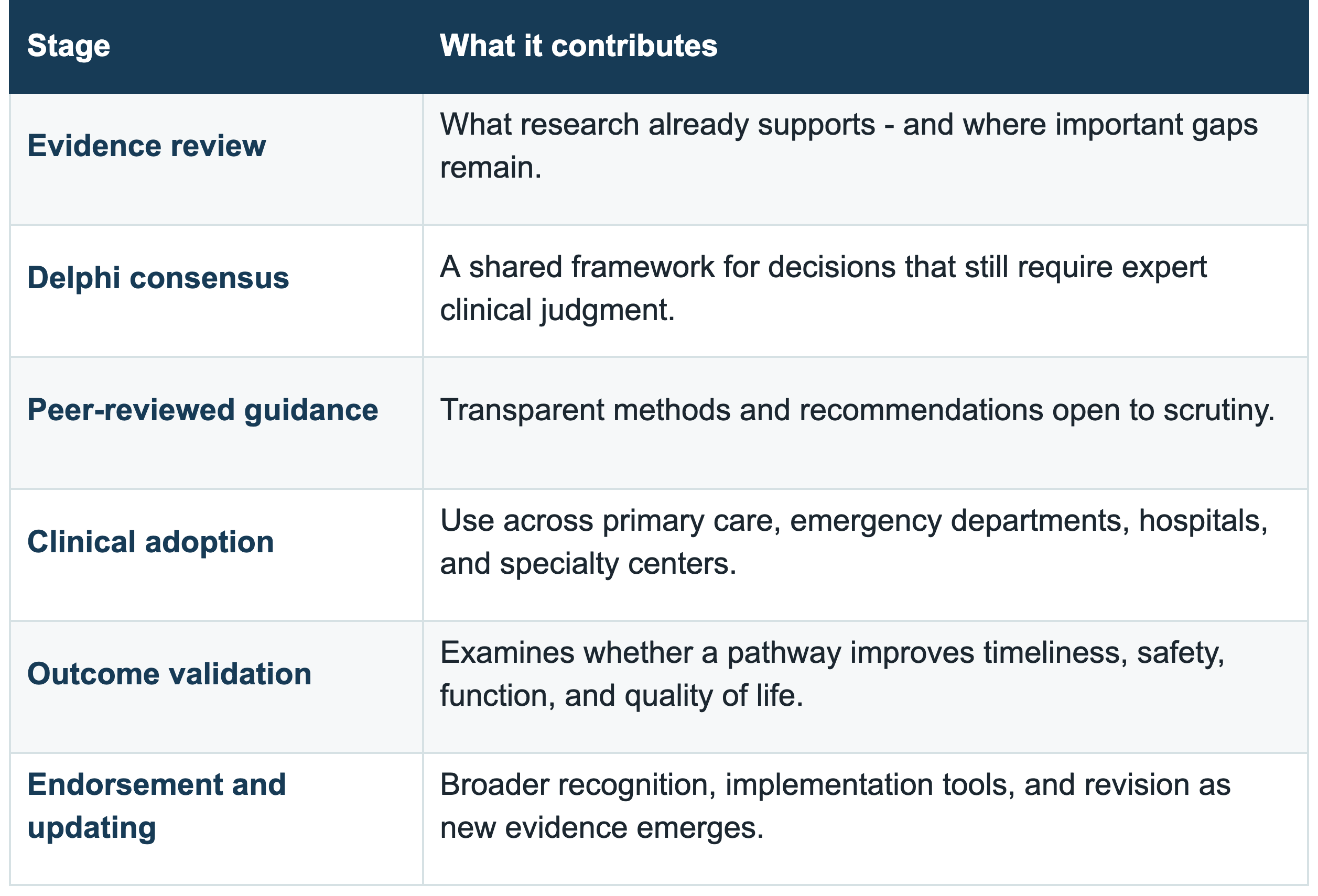
A Delphi does not, by itself, create a universal standard of care. That distinction matters. Standard of care evolves through multiple layers: published evidence, expert guidance, professional-society endorsement, adoption by health systems, clinician use, outcome validation, and continued revision.
The Stanford ASD Deterioration Delphi
On August 28-29, 2026, a multidisciplinary steering committee is scheduled to meet at Stanford University for the first meeting in a Delphi series focused on potentially treatable medical contributors to acute deterioration and regression in autistic individuals.
The effort is chaired by Drs. Russel Dale, Kevin Hoffman, and Jennifer Frankovich, with Delphi-method expertise from Terrence Thomas, and includes clinical experts from major research medical centers across the globe. The BRAIN Foundation is a sponsor of the meeting.
The first phase is intentionally foundational. Its working aim is to develop consensus statements that guide the identification, assessment, evaluation, and management of medical contributors to deterioration in people with autism. The opening meeting will generate core themes and early statements, establish working groups, and prepare the material for subsequent Delphi rounds.
- The questions are practical and overdue, for example:
- How should clinicians recognize a meaningful change from an individual’s established baseline?
- Which domains should be tracked – including communication, cognition, mood, sleep, movement, self-care, continence, eating, school or work, repetitive or aggressive behaviors, and social engagement?
- Which changes should trigger a medical/psychiatric evaluation, and how quickly should it occur?
- How should clinicians consider overlapping presentations such as catatonia, delirium, loss of skills, seizures, new psychiatric symptoms, or motor change?
- What should a differential-diagnosis toolkit include – from infection, pain, gastrointestinal illness, medication effects, and sleep disorders to neurological, metabolic, genetic, autoimmune, psychiatric, and environmental contributors?
- What belongs in a practical toolkit for documenting baseline function and comparing ‘before’ with ‘now’?
- How should evaluation occur in primary care, the emergency department, a specialty clinic, or the hospital?
- How can the evaluation and treatment be expedited?
What happens at the first meeting?
The first in-person meeting will establish the panel, clarify the scope of the work, and agree on the Delphi methods to be used.
Traditional Delphi vs. Modified Delphi
Unlike a traditional Delphi, which seeks consensus through repeated anonymous surveys, a modified Delphi begins with a review of existing evidence and typically uses a smaller multidisciplinary expert panel. Experts rate proposed recommendations anonymously, review the group’s responses, meet to discuss areas of disagreement, and then vote again. This combines independent judgment with structured discussion to produce practical, evidence-informed clinical recommendations.
Further, the purpose of the first meeting is:
- To have conversations which inform a set of statements that will guide identification, classification, evaluation, and differential diagnosis of deteriorations in individuals with ASD.
- Develop working groups and plan out meetings to develop statements.
In the upcoming sessions, clinicians will engage in an iterative review of clinical questions and existing data. This structured dialogue involves anonymous voting and recursive feedback, allowing the panel to hone recommendations across multiple rounds. The final, vetted consensus will be formatted for peer-reviewed dissemination.
Subsequent efforts will pivot toward real-world implementation, focusing on the systematic gathering of clinical data and the assessment of patient health outcomes. By applying these protocols in practice, aggregated and de-identified results will provide the evidence necessary to validate and continually refine the clinical pathway.
To ensure the guidelines remain current, the Delphi panel will assemble every year. This ongoing commitment allows for the regular updating of existing standards while initiating consensus work on new challenges facing the autistic community across the lifespan.
What makes this effort different
The initiative begins with a crucial premise: deterioration in individuals with autism may have more than one phenotype and more than one cause. Medical and psychiatric assessment should complement one another, not compete. Resource limitations must also be considered so that guidance is usable beyond a handful of highly specialized centers.
The proposed work does not begin by prescribing one treatment for every patient. It begins earlier and more safely: document the baseline, recognize the change, identify red flags, conduct a thoughtful evaluation, and avoid overlooking urgent or potentially reversible contributors. Future working groups are expected to develop an algorithm for suspected post-infectious/inflammation mediated deteriorations, and give practical management guidance for clinic, hospital, and intensive-care settings.
What success could look like
Imagine a family arriving at a primary-care office or emergency department and not having to prove from the beginning that the person they know has changed. The clinician has a baseline checklist, a set of warning signs, a differential-diagnosis framework, and clear criteria for escalation. Specialists communicate through a shared pathway. The family is treated as a source of essential longitudinal information. Data from implementation is used to improve the protocol.
The initiative begins with an important premise: deterioration in autism may have more than one presentation and more than one cause. Medical and psychiatric assessment should be complementary. A new change in behavior, functioning, communication, sleep, movement, or self-care should not automatically be assumed to be due to the underlying autism, especially when there is a sudden change in functioning.
The effort also recognizes that guidance must be practical. Recommendations that can only be used in a small number of highly specialized centers will have limited reach. A useful pathway should help community clinicians recognize concerning change, perform an appropriate initial assessment, understand when urgent escalation is needed, and know when specialty consultation may be helpful.
This work does not aim to prescribe one treatment for every patient. Its early focus is more basic—and potentially safer:
That is how a fragmented field begins to become a system of care. Not through a single proclamation, but through disciplined consensus, publication, adoption, measurement, and revision.
Success also means that access no longer depends on a family’s ability to doctor-shop. A person in a rural community, a nonspeaking adult, and a child seen at a leading academic center should all benefit from the same core expectation: a meaningful deterioration deserves a timely, respectful, medically informed response. Uniformity should apply to the quality of clinical reasoning – not force identical care on individuals whose needs differ. This high level of evidence-based care is the norm in other medical diagnoses, and should be the norm in medically complex ASD as well.
In this model, research centers serve as hubs rather than islands. They can evaluate the most complex cases, support multidisciplinary consultation, generate evidence, and improve the protocol. Community clinicians can use the same core framework, know when specialist referral is warranted, and participate in ongoing monitoring. The protocol becomes the bridge: between pediatrics and adult medicine, between one specialty and another, and between expert knowledge and equitable everyday care.
About this initiative
The Delphi Consensus Conference on Treatable Medical Causes of Acute Deterioration and Regression in Autism is a \ multidisciplinary effort by leading clinicians across the globe, initiated by the BRAIN Foundation (Dr. Srinivasan) and Stanford University (Drs. Frankovich and Hoffman). The Brain Foundation has committed to fully funding at least three Delphis over the next 3 years and each will lead to concrete improvements in clinical care for individuals with autism who have a deterioration. The first steering committee meeting is scheduled for August 28-29, 2026, followed by the Synchrony parent symposium on August 30.
Sources and further reading
- RAND: Methodological Guidance for Conducting and Critically Appraising Delphi Panels.
- RAND/UCLA Appropriateness Method User’s Manual.
- ACCORD reporting guideline for consensus methods in biomedicine (PLOS Medicine, 2024).
- EQUATOR Network: CREDES guidance for conducting and reporting Delphi studies.
- NICE example: Delphi consensus methods used when pediatric evidence was limited.
Be the first to hear!
Subscribe to our newsletter to get information about future events and updates
Join us on social
RESEARCH CONFERENCES
COMMUNITY EVENTS
CLINICIANS TRAINING
EDUCATIONAL WEBINARS
RESOURCES & PUBLICATIONS